






Stellantis and LGES Finish Construction of NextStar BEV Battery Facility in Canada
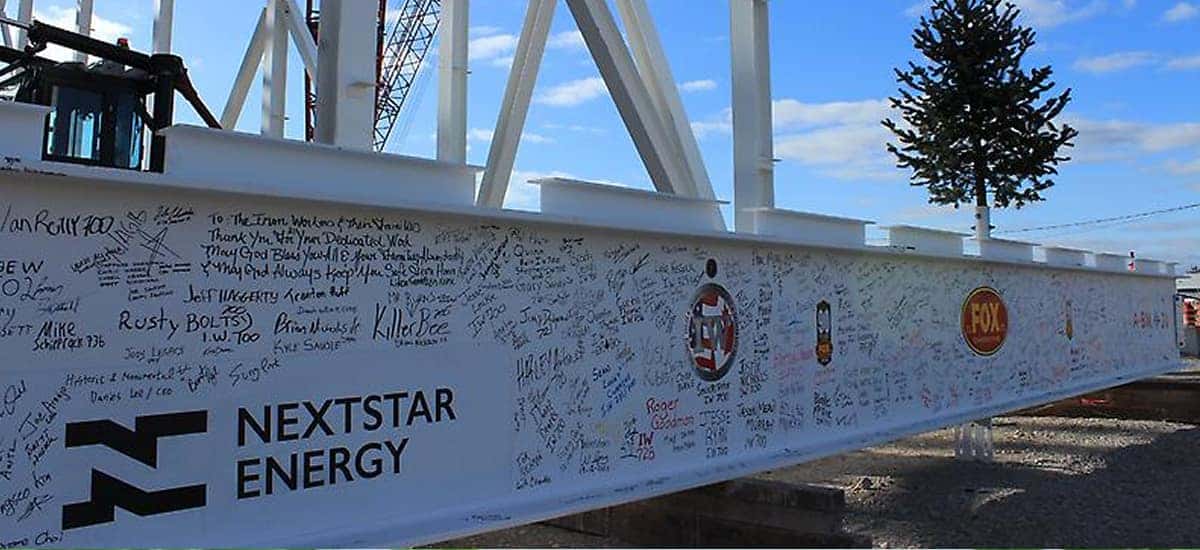
Back in 2022, Stellantis and LG Energy Solution (LGES) announced the official name of its battery joint-venture company, NextStar Energy Inc. The battery joint-venture company set out to build the first large-scale, domestic, electric-vehicle battery manufacturing facility in Canada, with operations planned for launch in 2024. Construction was slated to start later in the year, and now in late 2023, the company is holding a “Topping Out” ceremony with local trades employees to celebrate the completion of the construction as the last structural steel beam was installed. They actually placed the final steel beam as the main focus, with a ceremonial signing of the beam, team photos, and a speech.
“People driving by the facility daily are witnessing this historic building take shape as we near the end of the construction process and prepare to enter the installation process…We will have thousands of skilled experts at the site helping to build a world-class facility that will produce leading-edge lithium-ion battery cells and modules for the next generation of electric vehicles. We are grateful to the nearby businesses and residents for their patience during the construction process.” – Danies Lee, CEO NextStar Energy
Now, that’s what I call a quick turnaround. Construction started in August 2022 with site clearing, mass grading, and foundation activities. Two major buildings were designated for construction – the Module Building and the Cell Building. The Module Building has been completed, and the Cell Building is nearing completion, with 40 percent completed. Now, NextStar Energy can move onto the next step in the plan. Following its construction of the BEV battery plant, a nearly 4.23 million square foot facility, the next step is to install the proper equipment and machinery to get the job done.
The project is going to create a lot of jobs, requiring up to 3,200 tradespeople and equipment installers. With the Cell Building only 40 percent complete, 1600 of those people will continue working on instruction while the other 1600 start the installation process of the project. Because the facility is being built on Canadian soil, Canadians will also make up a large chunk of the workforce – 2300 Canadians have put in nearly 1,600,000 labor hours since the construction portion of the project started, with a total of 950 craft workers. Another 2500 new jobs in Windsor, Canada, are expected to open up.
Stellantis and LGES invested more than $4.1 billion USD ($5 billion CAD) into the construction of this facility. With a goal of cranking out an annual production capacity of +45 gigawatt hours (GWh) in 2022, the new estimate is 49.5 GWh. Once construction is complete, NextStar will be able to produce leading-edge lithium-ion battery cells and modules for future BEVs. Of the 49.5 GWh produced, 40 percent will be used for the future Stellantis BEV lineup in North America. In 2022, Stellantis shared its Dare Forward 2030 business strategy, discussing plans for the future of its lineup, with the first major goal of producing 75 new BEVs by 2030, 25 of which will make it to the U.S. The construction of the NextStar BEV battery plant is one step closer to its goal